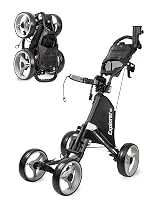
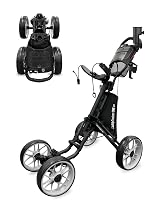
Golf Push Cart That Follows You: How to Choose
The best golf push cart that follows you for most walkers is the NAVEE Birdie 3X, because it pairs UWB follow-me with a 36-hole battery and a 3-second fold. Buy a follow cart only if you walk often and your course allows motorized carts on the fairway.
On this page (9 sections)
- What does follow mode do on a golf push cart that follows you?
- Which cart tech should you check before you buy?
- How much battery do you need for 18 holes?
- What slope rating should a follow electric cart handle?
- Which folding size fits your trunk?
- Which follow cart would we pick for most walkers?
- Should you buy a follow cart or stay with a push cart?
- How do you set up and care for a follow cart?
- Which golf push cart that follows you should you buy?
The best golf push cart that follows you for most walkers is the NAVEE Birdie 3X, because it pairs UWB follow tech with a 36-hole battery, a 3-second fold and a 3-year warranty. It walks behind your tag, so your hands stay free between shots.
Buying a follow cart is a bigger decision than buying a push cart. You are paying for motors, radio tracking and a battery, and the cart has to handle your course, your trunk and your walking pace.
This guide covers what those specs mean on the course, which numbers matter most, and the three carts we would shortlist. Every claim below comes from the makers' published specs, not from a round on the grass.
What does follow mode do on a golf push cart that follows you?
Follow mode makes the cart move toward a small tag you carry, so you walk with both hands free. It is the single feature that separates these carts from a plain push cart or a remote cart.
The trick is the radio, not a camera. UWB (ultra-wideband) sends short pulses between the cart and the tag, and the cart works out direction and distance from the timing.
NAVEE and KEMIMOTO both use UWB, and the G5 uses sensors to track its remote.
You normally clip the tag to your belt or drop it in a pocket. KEMIMOTO says its remote can sit in a pocket or clip to your belt.
On the G5, follow mode needs the battery on and the handheld remote active.
Distance behavior differs by cart. KEMIMOTO says its caddy stays still when the remote is within about 5.9 ft, then starts following once you move past that.
That gap keeps the cart from nudging your heels on a slow walk.
Two things follow mode does not do. It does not steer around obstacles, and it does not know where the green is.
KEMIMOTO states its follow mode has no obstacle avoidance. Treat follow mode as a hands-free push, not a self-driving caddy.
Which cart tech should you check before you buy?
Check the tracking tech first, then the remote range and the control modes. UWB tracking and a belt-clipped tag give the smoothest walk, while a long-range remote helps when the cart is ahead of you on the fairway.
The tag matters more than people expect. A tag on your belt tracks your body.
A tag in a back pocket tracks whichever side it sits on, and KEMIMOTO notes its cart veers toward the side where the remote is placed. Clip it centrally if you want a straight line.
Remote range sounds like a headline number, but it mostly covers the moments when follow mode is off. KEMIMOTO rates its remote at up to 492 ft, and NAVEE rates its remote at 100 m with an app at 200 m.
In practice you use the remote to bring the cart to you or park it near the next tee.
Control modes tell you how the cart behaves when follow is not the answer. The G5 lists five: hand push, remote, one-touch recall, follow me and constant speed cruise.
NAVEE adds power assist with nine speed settings from 0.6 to 5.6 mph. KEMIMOTO has a power assist mode that matches your walking pace: push to go, release to stop.
Rule: if you walk crowded fairways with sharp turns, weight power assist and the remote higher than follow tech. Follow mode shines on open fairways, not in traffic.
How much battery do you need for 18 holes?
You need a battery rated for at least 36 holes if you walk twice a week, because one charge should cover two rounds. All three carts here clear that bar, and the G5 goes further with a 45-hole rating.
Battery size in holes is a maker estimate, not a guarantee. Wet grass, long rough, hills and cold mornings all pull more current.
If your course climbs, plan on charging after every round even with a big battery.
The G5 carries the largest reserve of the three at 45 holes, and it uses a UL 2271-certified battery. NAVEE rates the Birdie 3X at 36 holes from a UL 2271-certified pack, with a 3-year warranty on the cart and one year on the battery and charger.
KEMIMOTO uses a 220 Wh lithium pack rated for up to 36 holes, with a smart BMS to protect the cells, backed by a 12-month warranty.
Charge time is the other half of the habit. A bigger pack takes longer to fill, so a wall socket at the club or a garage outlet near your car makes the routine easier.
Keep the battery out of a hot trunk between rounds. Heat ages lithium cells faster than cold, and a battery that lives in a car all summer loses its edge.
Rule: buy the smallest battery that covers your walking week plus one spare round. Beyond that you are carrying weight you rarely use.
What slope rating should a follow electric cart handle?
Look for a 25% slope rating if your course has real hills, and 30° if it climbs steeply. A weak motor shows up on the first hill, not on the flat, so match the number to your home course.
Makers quote slopes in two units, which makes comparison confusing. NAVEE rates the Birdie 3X at inclines up to 25% with its twin 240W motors.
KEMIMOTO rates the ApexAI at slopes up to 25% (about 14°) with dual 240W motors. The G5 claims stability on 30° slopes with dual anti-tip wheels.
Percent and degrees are not the same scale, so read the unit. A 25% grade equals about a 14° slope, so NAVEE and KEMIMOTO quote the same incline in different units.
If your course has one long climb, ask the pro shop how steep it is and compare against those figures.
Downhill control matters as much as climbing power on a loaded cart. NAVEE includes downhill speed control to regulate the descent, which keeps a heavy bag from running away on a steep hole.
Motor power alone does not tell you how a cart handles. Wheel size, tire grip and anti-tip support all play a part.
The Birdie 3X runs 10-inch all-terrain wheels with a fifth anti-tip wheel. KEMIMOTO uses upgraded rubber tires and a 12.2-inch anti-tip wheel for rear support on climbs and turns.
Rule: match the slope rating to the steepest hole you walk weekly, and pick the cart with downhill control if that hole is a descent.
Which folding size fits your trunk?
Measure your trunk opening before anything else, because all three carts here fold close to the same box. The Birdie 3X and the ApexAI both fold to 26.8 x 22.2 x 15.1 in.
The G5 folds to 28.7 x 24.8 x 14.1 in.
The fold speed is where they separate. NAVEE says the Birdie 3X folds in one step in about 3 seconds.
The G5 also folds in 3 seconds. That matters in a crowded car park when rain is coming.
Folded size is not the whole story. The G5 needs about 10 minutes of assembly out of the box, with 90% of parts pre-assembled, so plan a setup session before your first round.
The Birdie 3X comes with a phone holder, umbrella holder, cup holder and storage net, which all take trunk space.
Weight matters if you lift the cart into a high trunk or up stairs. The Birdie 3X weighs 37.7 lb with an aluminum frame.
A follow cart is heavier than a plain push cart because of the motors and battery, so test the lift before you buy.
If folding and trunk fit are your main worry, our guide to the best folding golf push cart covers the compact end of the market. The how to fold a golf push cart walkthrough helps if a one-step fold still baffles you on the first try.
Rule: if your trunk is tight, measure the opening, not the floor. A cart that fits the floor but not the lip is a cart you lift twice.
Which follow cart would we pick for most walkers?
We would pick the NAVEE Birdie 3X for most walkers, because it brings follow tech, a 36-hole battery, downhill control and a 3-year warranty into one package. The other two win on specific needs.
The Birdie 3X covers the basics a follow-cart buyer wants. Follow mode handles the walk, the remote takes over when you want control, and the 5.5-inch LED display shows battery, speed and distance.
Nine speed settings from 0.6 to 5.6 mph let you set a pace and forget it, and the USB-C port keeps your phone alive. IPX5 water resistance handles dew and light rain, and the battery and vehicle both carry UL safety certification.
Add the included umbrella holder, cup holder and storage net and the cart is ready on day one.
It suits a walker who plays two rounds a week on a hilly course and wants one cart to do it all.
The ApexAI suits the player who parks the cart ahead and steers from a distance. The remote reaches up to 492 ft, which is far more than you need on most holes but useful when the cart sits near the next tee.
Power assist matches your walking pace, which helps on narrow paths. Dual 240W motors handle 25% slopes, and the 12.2-inch anti-tip wheel adds rear support on turns.
The 5.68-inch LED display shows speed, battery and remote connection, and the USB-C port charges your phone.
It suits a walker on an open course who likes to send the cart ahead rather than tow it.
The G5 suits the player who wants the biggest battery reserve and the most control options. The 45-hole battery covers two full rounds with room to spare, and the control list runs from hand push to constant speed cruise.
The color LED display shows speed, battery, mode and mileage. IPX5 water resistance covers wet mornings, and the battery is UL 2271 certified.
It comes with an umbrella holder, cup holder and toolkit, and it assembles in about 10 minutes.
It suits a walker who plays long days, carries a heavy bag and wants to switch modes often.
| Product | Best for | Our score |
|---|---|---|
| NAVEE Birdie 3X Follow Electric Cart | overall | 7.6 |
| KEMIMOTO ApexAI Follow Electric Caddy | long-range remote control | 7.4 |
| G5 Auto-Follow Electric Push Cart | big battery reserves | 7.1 |
Should you buy a follow cart or stay with a push cart?
Stay with a push cart if you walk fewer than one round a week or your course bans motorized wheels on the fairway. Buy a follow cart if walking is your habit and hands-free travel is worth the price.
A follow cart is heavier and costs more than a push cart, and it adds a battery to your charging routine. Those costs buy a hands-free walk and less push effort on hills.
A plain push cart still wins on simplicity, weight and price.
If you want four stable wheels and no motor, read our best 4-wheel golf push cart picks. If your shoulders or knees make pushing hard work, a motor helps most, and our golf push cart for seniors guide covers the low-effort options.
Check the rules before you order. Some courses allow remote carts on paths only, and a few ban motorized carts outright.
A quick call to the pro shop saves a wasted purchase.
Rule: if you walk weekly and your course allows it, buy the follow cart. If either answer is no, a push cart serves you better.
How do you set up and care for a follow cart?
Set the cart up once at home, then charge after every round and clean the wheels before storage. Small habits keep follow tech and motors working, and they take five minutes.
Start with the pair. Follow mode tracks a tag, so pair the tag with the cart before the first round and again if it drops.
Clip the tag to the center of your belt, not a back pocket, so the cart tracks your body line.
Test the stop distance on open ground. KEMIMOTO's cart holds still within about 5.9 ft of the remote, and other carts behave in their own way.
Learn the gap before you walk a crowded fairway.
Charge after every round, even if the battery shows plenty. Lithium packs last longer when kept off empty, and a full pack means no mid-round surprise.
Store the cart folded and dry, with the wheels clear of mud.
Check the anti-tip wheel and the tires for wear at the start of each season. These parts carry the cart's stability on slopes, and a worn tire grips less on wet grass.
Rule: pair, charge, clean. Do those three things and your follow cart stays ready for the next round.
Which golf push cart that follows you should you buy?
Buy the NAVEE Birdie 3X if you want one follow cart that handles hills, trunk space and a full weekend of play. It is the best all-round pick here, and the 3-year warranty backs it.
The decision rule is simple. Pick the Birdie 3X for the best balance of follow tech, battery, folding and warranty.
Pick the KEMIMOTO ApexAI if a long remote range and pace-matching power assist matter most. Pick the G5 if battery size and five control modes top your list.
Any of the three turns a walk into a hands-free round, and each one follows a tag you carry. Match the cart to your hills, your trunk and your walking week, then test follow mode on open grass before you take it to a crowded course.
Our score weighs specs, features and buyer feedback against what you're shopping for.
Frequently asked questions
Do follow carts avoid bunkers and trees on their own?
No. Follow mode steers toward the tag, so it will drive the path you take.
KEMIMOTO states its follow mode has no obstacle avoidance, so pick a clear line and keep the remote ready.
How long does the battery last on a follow electric cart?
The three picks here are rated for 36 to 45 holes per charge, so most players get two full rounds. Cold mornings, wet grass and hilly courses drain more, so charge after every round if you walk twice a week.
Are follow carts allowed on the fairway at my course?
Many courses allow remote and follow carts but some restrict motorized wheels to the rough or cart paths. Ask the pro shop before your first round, and be ready to switch to push mode if the rule is no.
Can I still push a follow cart if the battery runs out?
Yes. All three models here include a manual push mode, so you finish the round on foot power if the battery dies.
It rolls heavier than a plain push cart because of the motors, so keep a charge habit.