What to Look for in a Golf Push Cart
What to look for in a golf push cart comes down to four things: wheels and a brake that hold on your course, a fold size that fits your trunk, a handle height that suits your posture and storage that keeps your gear dry. Check those first, then match the frame to your terrain.
On this page (8 sections)
- Which wheels and brake should you look for in a golf push cart?
- How small should a folding golf push cart be?
- What handle height and grip keep you comfortable?
- How much storage does a golf push cart need?
- How strong should the frame be for your terrain?
- How should you test a push cart before you buy?
- What should you skip when choosing a golf push cart?
- The bottom line on what to look for in a golf push cart
What to look for in a golf push cart comes down to four things: wheels and a brake that hold on your course, a fold size that fits your trunk, a handle height that suits your posture and storage that keeps your gear dry. Check those first, then match the frame to your terrain.
A push cart is a tool you use for three or four hours at a time, so small design choices matter more than they look on a spec sheet. A wheel that tracks straight saves you steering effort all round.
A handle at the wrong height makes your back ache before the turn.
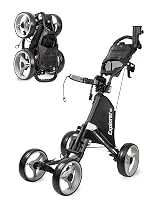
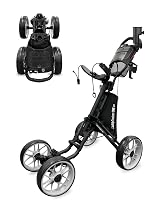
The three carts below show how the same set of choices plays out in different designs. The findway Golf Push Cart 3 Wheel is the best pick overall for most walkers, with the Clicgear Model 4.5 close behind for storage and the Caddytek CaddyLite 11.5 V3 leading on weight.
Which wheels and brake should you look for in a golf push cart?
Start with the wheels and the brake, because they decide how the cart rolls and whether it stays put on a slope. A 3-wheel cart pivots around its front wheel.
A 4-wheel cart spreads its weight over a wider rectangle.
Wheel size matters less than the tire material and the wheelbase. EVA tires need no air and won't go flat, which removes a common source of mid-round trouble.
A long wheelbase lowers the center of gravity and steadies the cart on rough ground.
Check the brake type too. A foot brake locks the wheels with a step, which suits players who stop often to line up a shot.
A hand brake gives finer control on hills but asks you to keep a grip on the handle.
3 wheels or 4 wheels?
A 3-wheel cart steers more sharply and rolls easily across open fairways. Its narrow front end lets you turn in tight spots near the green.
The trade-off is less sideways stability when the cart leans.
A 4-wheel cart is the steadier option on hilly or uneven courses. Two front wheels keep the cart from tipping when it rests on a slope.
The cost is a slightly wider turning circle and more bulk when folded.
Pick 3 wheels for flat, open courses and 4 wheels for hills, then confirm the wheelbase and wheel sizes in the specs. If steering ease matters most to you, see our roundup of the best 4 wheel golf push cart options.
The findway cart takes the 3-wheel route with a full 360° rotating front wheel. It turns almost in place, which helps when you walk a tight path between bunkers.
Its 10.5 in rear wheels and 8 in front wheel sit on a widened base. EVA tires mean no pumping and no flats.
A foot brake locks the cart with one step.
Choose this cart if you walk a flat or rolling course and want sharp steering. Skip it if your home course is steep and you want the extra lean resistance of four wheels.
How small should a folding golf push cart be?
Match the folded size to your trunk before anything else, because a cart that doesn't fit is a cart you leave in the garage. Folded length matters most in a sedan.
Folded depth matters in a hatchback or SUV.
Measure the opening and the depth of your trunk, then compare against the folded dimensions. Leave a little room for a golf bag and shoes alongside.
If the cart fills the trunk on its own, you'll be moving it every time you load groceries.
The number of fold steps is a smaller factor. A two-step fold saves a little time at the car.
A quad-fold packs flatter but takes an extra motion. Both are quick once you've done it a few times.
Folded sizes and what fits where
The findway folds in two simple steps to about 20.08 in long by 15.75 in wide by 34.45 in high. That shape drops easily into a sedan trunk beside a golf bag.
It weighs 15.21 lb, with handlebars built in for lifting.
The Clicgear Model 4.5 folds to a compact 13 in by 15 in by 24 in block. The small footprint suits a hatchback, a locker or a crowded garage corner.
It weighs 16 lb.
The Caddytek CaddyLite 11.5 V3 uses a 3-step quad-fold system and packs to a flat 28 in by 16.5 in by 16.1 in. At 13.75 lb it's the lightest cart here.
The flat shape slides under a shelf or into a low trunk.
Pick the flat quad-fold if you lift the cart often or store it in a tight spot. Pick a taller fold if your trunk has plenty of height but little floor area.
Our guide to the best folding golf push cart covers more compact options.
What handle height and grip keep you comfortable?
Look for a handle with at least two height settings, and stand behind the cart before you buy if you can. A handle that sits too low makes you hunch.
One that sits too high makes you reach and loses control on slopes.
The findway cart offers four handle heights. That range covers shorter and taller players and lets you find a position where your arms stay relaxed.
Its sliding latch locks the handle firmly in place so it doesn't drift on uneven grass.
Grip shape matters on long rounds. A wide, padded grip spreads pressure across your palm.
A thin grip can be easier to hold on hot days when your hands get sweaty.
Check the folding lock as well. A latch that clicks firmly into place stops the cart from collapsing while you push.
A loose latch is a common frustration on cheaper carts.
Who each handle design suits
The findway's four levels suit a household where more than one person uses the cart. Tall players can raise it, shorter players can lower it, and the sliding latch holds the setting.
The Clicgear's adjustable upper and lower bag saddles are separate from the handle, but they keep the bag from shifting as you push. A stable bag means the handle stays balanced in your hands.
The Caddytek's TPR handle adjusts to fit golfers of any height. TPR is a rubbery material that grips well when wet.
It also includes a foot-activated brake for stopping power on slopes.
Pick a cart with several handle positions if more than one person will use it. Pick a fixed handle only if you've confirmed the height suits you.
Senior golfers often want a higher setting and a lighter cart, which our roundup of the golf push cart for seniors covers in detail.
How much storage does a golf push cart need?
Look for a cart with room for your phone, a drink, an umbrella and a few balls, then check how well those pockets stay closed. Storage is where cart designs differ most, and it's the feature you'll notice every round.
A good console holds your phone where you can see it and keeps a scorecard flat. An umbrella mount frees a hand when rain arrives.
A drink holder should fit your usual bottle, not just a skinny can.
Under-console storage adds room for a jacket, snacks or a rangefinder. Mesh nets and ball racks keep small items from rolling around.
Check that pockets have flaps or zips so nothing falls out on bumpy ground.
Storage that holds up on the course
The Clicgear Model 4.5 has the richest storage here. Its console includes a sound-amplifying phone holder with charging cord access.
Magnetic and hook-and-loop pads hold small items. There are slots for a scorecard, a golf ball, a pencil and tees.
It also adds a storage bag under the console, a mesh basket and an umbrella mount. The drink holder is redesigned to fit everything from skinny cans to wide bottles.
Multiple accessory mounting points let you add more later.
The findway cart covers the basics well. It has storage pockets and holders for drinks, phones, umbrellas and rangefinders.
Racks and mesh pockets hold golf balls and tees. An adjustable top bracket with elastic straps fits bags of various sizes.
The Caddytek keeps storage simple. It includes a mesh net under the handle, a magnetic pad for a towel or rangefinder, an umbrella holder and a drink holder.
Elastic straps secure most bags, including oversized ones.
Pick the Clicgear if you carry a lot of gear and want everything organized. Pick the findway if you want solid storage without paying for a premium console.
Pick the Caddytek if you'd rather keep the cart light.
How strong should the frame be for your terrain?
Look for a lightweight aluminum frame with a low center of gravity, because those two features decide how the cart handles slopes and rough ground. A heavier frame feels steady but is harder to lift.
A lighter one is easier to move but needs a wide base to stay stable.
The findway uses a high-strength aluminum alloy frame. Its optimized balance and low center of gravity reduce the risk of tipping.
The long wheelbase adds stability across a range of terrain. A sliding latch locks the handle so it holds on slopes.
The Clicgear frame is aircraft-grade aluminum with a scratch-resistant finish. Internally routed brake cables keep the frame clean and protect the cable from snags.
Adjustable bag saddles and silicone straps hold the bag secure.
The Caddytek frame is lightweight aluminum built for all-weather play. Its wide wheelbase and dual 11.5 in rear wheels give it reliable balance and control.
It's the lightest of the three at 13.75 lb.
Frame choices by course type
On a flat course, a lighter frame saves effort over 18 holes. The Caddytek's low weight and wide wheels suit walkers who cover a lot of ground.
Its 1-year limited warranty covers manufacturing defects.
On a hilly course, a low center of gravity and a long wheelbase matter more than a few pounds. The findway's triangular chassis and widened base give it balance on slopes.
A foot brake locks it while you take a shot.
If you play year-round in wet conditions, a scratch-resistant frame and protected brake cables help. The Clicgear's internally routed cable and aluminum frame suit regular use in rain.
Pick the lightest frame you can steer comfortably, then add stability features if your course is hilly. If your cart will live in a garage or locker between rounds, a compact fold matters as much as weight.
How should you test a push cart before you buy?
Stand behind the cart, grip the handle and push it a few steps if a store lets you. That short test tells you more about handle height and steering than any spec sheet.
If you buy online, match the specs to your body and your course.
Check the folded size against your trunk first. Then look at the handle settings and the wheel type.
Finally, read the storage layout to see if it fits how you play. A cart that suits your routine gets used every round.
Consider how often you walk and how far. A player who walks 18 holes twice a week needs a cart that rolls easily and folds quickly.
An occasional player can accept a heavier cart for more storage.
Think about the bag you use. The findway's adjustable top bracket fits bags of various sizes.
The Clicgear fits most stand and cart bags. The Caddytek's elastic straps secure most bags, including oversized ones.
A short checklist for the store or the specs page
Use this list to compare carts side by side. Each item maps to a real feature on the carts above.
- Wheel count and wheel size: 3 or 4 wheels, and whether the tires are EVA.
- Brake type: foot or hand.
- Folded dimensions and fold steps.
- Handle height settings and grip material.
- Storage: console, under-seat bag, mesh net, umbrella mount, drink holder.
- Frame material and weight.
- Warranty length.
If you want one cart that covers most needs, the findway's 360° steering and four handle heights make it the easiest to live with. If storage is your priority, the Clicgear's console does more.
If weight is your priority, the Caddytek is the lightest.
Once you've chosen, learn the fold so you can pack up quickly. Our walkthrough on how to fold a golf push cart covers the common folding systems step by step.
What should you skip when choosing a golf push cart?
Skip features that add weight or cost without helping your round. A cart with a large storage console weighs more to lift.
A premium frame costs more without changing how it rolls on a flat course.
Don't pay extra for a brake you won't use. If your course is flat, a simple foot brake is enough.
A hand brake adds control on hills but asks more of your grip.
Don't choose a cart by wheel count alone. A well-balanced 3-wheel cart can be steadier than a poorly designed 4-wheel one.
Check the wheelbase and center of gravity instead.
Don't overlook the fold. A cart that takes a minute to fold and doesn't fit your trunk will end up staying home.
The best cart is the one you actually take to the course.
Features worth paying for and features to skip
Worth paying for: a 360° or adjustable front wheel, a brake that locks firmly, a handle with several height settings and EVA tires. These affect every round.
Worth paying for if you carry gear: a console with a phone holder, an umbrella mount and under-console storage. These keep your hands free and your gear dry.
Skip: oversized consoles if you want a light cart, extra mounting points you won't use and a premium frame if you play a flat course. Each adds cost or weight without changing the basics.
Decide what you need from your course and your trunk first, then pay only for those features. The carts above show the trade-offs clearly: the findway balances steering and storage, the Clicgear leans toward storage and a compact fold, and the Caddytek keeps weight low.
If you're still unsure between wheel counts, our 4 wheel golf push cart roundup shows what the extra wheel buys you. And if you're shopping for a lighter cart for an older player, the golf push cart for seniors guide covers weight and handle height in more depth.
The bottom line on what to look for in a golf push cart
Look at wheels and brake first, then folded size, then handle height and storage. Those four checks cover most of what makes a cart easy or annoying to use.
The findway Golf Push Cart 3 Wheel is the best pick overall for most walkers, with its 360° front wheel and four handle heights.
The Clicgear Model 4.5 is the best choice if you carry a lot of gear and want a compact fold. The Caddytek CaddyLite 11.5 V3 is the best lightweight option if lifting the cart is your main concern.
Whatever you choose, match the cart to how you actually play. A flat course calls for sharp steering.
A hilly one calls for stability. A small trunk calls for a compact fold.
Get those right and the cart will earn its place in your car every week.
Our scoring weighs specs, features and buyer feedback against what you're shopping for. Use it as a starting point, then check the details that matter most for your course and your car.
Frequently asked questions
What should I check first when choosing a golf push cart?
Check the wheels and brake first, because they decide how the cart rolls and whether it holds on your course's slopes. Then check the folded size against your trunk and the handle height against your posture.
Storage and frame strength come after those three.
Is a 3-wheel or 4-wheel golf push cart better?
A 3-wheel cart turns more sharply and is easier to steer around the green, while a 4-wheel cart sits more firmly on steep or uneven ground. Pick 3 wheels for flat, open courses and 4 wheels if your home course has hills.
How do I know a push cart's handle height suits me?
Look for a handle with several height settings and stand behind the cart before you buy if you can. A cart with two or more positions, like the findway's four levels, lets tall and shorter players push with straighter arms and less strain.
How small does a golf push cart fold?
Folded sizes vary widely: the findway collapses to about 20 x 16 x 34 in and the Caddytek to a flat 28 x 16.5 x 16.1 in block. Measure your trunk opening and depth, then compare against the cart's folded dimensions before you buy.
Do I need a brake and a drink holder on a push cart?
Yes to the brake, because a cart without one rolls away on slopes and can damage clubs. A drink holder, umbrella mount and phone pocket are convenience features.
Most carts in this price range include all three.