8 Best Budget Electric Golf Push Carts (November 2026)
The best budget electric golf push carts for walking golfers include the Certified Brands MGI Zip Navigator All-Terrain Remote Controlled (best overall), the CaddyTek CaddyLite 11.5 V3 Push Cart (best manual fallback), and the CaddyTek CaddyLite ONE-Swivel V8 Cart for turning on tight fairways.
On this page (9 sections)
- The best budget electric golf push carts for every kind of walker
- How these budget electric golf push carts compare
- How we compared these carts
- Is a budget electric golf push cart worth it over a manual cart?
- Which folding size fits your trunk?
- Remote control or follow mode: which do you need?
- How much battery range do you need?
- Are these carts stable enough for senior walkers?
- The verdict: which budget electric golf push cart should you buy?
The best budget electric golf push cart for most walkers is the Certified Brands MGI Zip Navigator All-Terrain Remote Controlled, thanks to its 36-hole battery and a remote that runs speeds from 1 to 20. It folds to 27.55 x 18.5 x 16.5 in with the rear wheels reversed, so it fits a trunk without a wrestling match.
If you mostly walk flat courses and want to spend less, the CaddyTek CaddyLite 11.5 V3 is a 13.75 lb manual cart that folds flat and costs far less than any motorized option. Between those two ends sit six more carts, each solving a different walking problem.
The picks below cover remote carts, manual carts and one cart that starts manual and upgrades to electric later. A budget electric golf push cart does not have to mean a weak motor or a tiny battery, but you do trade something at every price point.
Our picks at a glance
-
1
 Best overall
Certified Brands MGI Zip Navigator All-Terrain Remote Controlled
8.8/10 our score
See it on Amazon -
2

-
3
 Best for turning on tight fairways
CaddyTek CaddyLite ONE-Swivel V8 Cart
8.3/10 our score
See it on Amazon
- 4
 Best for upgrading to electric laterCheck it
- 5
 Check it
Tivor 3-Wheel Handbrake Push Cart
Best for wet grass and slopes - 6
 Best for phone and scorecard storageCheck it
- 7
 Best for small trunksCheck it
- 8
 Check it
G5 Auto-Follow Electric Push Cart
Best for hands-free walking
The best budget electric golf push carts for every kind of walker
Start with how far you walk and how steep the course runs. A flat 18 with wide fairways needs less motor and less battery than a hill course with tight paths.
The first product here covers both well, and the rest are the best answer for a specific need.
Certified Brands MGI Zip Navigator All-Terrain Remote Controlled: Best overall
- 36-hole click and go battery
- Twin motors with remote
- Folds to 27.55 x 18.5 x 16.5 in with rear wheels reversed
- 35 lb with battery
A remote-controlled cart with a long-range battery and all-terrain rear wheels. It folds smaller than its weight suggests.
Pros
- 36-hole battery covers two rounds
- Remote plus variable speed from 1 to 20
- USB port under the handle
Cons
- 35 lb is heavy to lift into a trunk
- Needs the battery charged before every round
The MGI Zip Navigator AT is the pick for walkers who want the full electric experience without paying premium-cart money. Its 36-hole battery covers two rounds on one charge, which matters on weekend trips where an outlet is not always handy.
Twin motors do the pushing, and the remote runs speeds from 1 to 20, so you can match the pace of your group. The 35 lb weight with battery is the trade-off: lifting it into a high trunk takes some effort.
Once it's out, the walk itself is easy. The zip folding frame is 12% lighter and 25% smaller than earlier MGI designs, and the rear wheels invert on the axle to shrink the footprint further.
The top box holds a digital display, a USB port for your phone and holders for a drink and umbrella.
Pick it for two-round weekends and mixed terrain. Choose a manual cart instead if you rarely walk 18 or your course is flat.
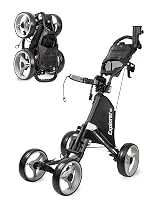
CaddyTek CaddyLite 11.5 V3 Push Cart: Best manual fallback
- 13.75 lb aluminum frame
- Quad-fold to 28 x 16.5 x 16.1 in
- Dual 11.5 in rear wheels
- Foot brake
The lightest cart here and a low-cost way to walk. No motor, no battery, no charging routine.
Pros
- Lightest pick in this group
- Folds flat in seconds
- Foot brake holds on slopes
Cons
- No motor, so you do all the pushing
- No remote or follow mode
The CaddyTek CaddyLite 11.5 V3 is the answer for walkers who want a low-cost cart without a battery to charge. At 13.75 lb, it's the lightest cart in this group and light enough to carry in one hand from the car.
The quad-fold frame collapses in three steps to 28 x 16.5 x 16.1 in. Dual 11.5 in rear wheels and a 10.5 in front wheel roll smoothly over fairways and rough, and the wide wheelbase keeps a loaded bag steady.
An adjustable TPR handle fits golfers of different heights, and the foot brake holds on slopes. Storage includes a mesh net, a magnetic pad, an umbrella holder and a drink holder.
Elastic straps grip most bag sizes, including oversized ones. The trade-off is obvious: you push.
No motor, no remote, no follow mode.
For a flat course and a light bag, that's fine. Pick it as a budget fallback or a second cart for days you want the exercise.
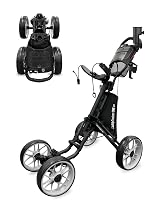
CaddyTek CaddyLite ONE-Swivel V8 Cart: Best for turning on tight fairways
- 360 degree swivel front wheel
- One-click folding
- 32 in wheelbase
- Cooler basket and console
A manual cart with a swivel front wheel that turns easily and a cooler basket built into the frame.
Pros
- Swivel wheel locks for straight lines
- Wide 32 in stance
- Cooler basket with insulated liner
Cons
- 19.6 lb is heavier than the CaddyLite 11.5
- Manual only, no motor option
The CaddyLite ONE-Swivel V8 suits walkers who weave around bunkers and tight paths. Its 360 degree swivel front wheel turns the cart on a dime, then locks into a straight line when you want it to track behind you.
The wide 32 in wheelbase keeps it stable, and the quick-action foot brake stops it on slopes. A one-click folding system collapses it to 16.5 x 20.5 x 29.3 in, which is larger than the CaddyLite 11.5 when folded.
Storage is the standout: a cooler basket with an insulated liner, a scorecard console, a phone and GPS mount, a mesh net and a magnetic pad. That's more places to put things than most carts at this level.
At 19.6 lb it's heavier than the CaddyLite 11.5, so it's less fun to lift in and out of a car. Pick it if maneuverability and storage matter more than weight, or if your course has narrow paths between greens.
Alphard Cybercart Push+: Best for upgrading to electric later
- Aircraft-grade aluminum frame
- One-click folding to 20 x 15.5 x 22 in
- Takes a motor upgrade kit sold separately
- 2-year warranty
A manual cart built on the same frame as Alphard's electric caddy. Add the motor kit when your budget allows.
Pros
- Converts to a remote electric cart later
- Lockable 360 degree front wheel
- Dual rear brakes
Cons
- Starts as a manual push cart
- The motor kit is an extra cost
The Alphard Cybercart Push+ is for the walker who wants a premium frame now and a motor later. It uses the same aircraft-grade aluminum frame as Alphard's award-winning electric cart, with a low center of gravity that keeps it steady on slopes.
Sealed low-resistance bearings and precision-aligned wheels make it roll with less push effort than a typical manual cart. The 360 degree front wheel locks into a fixed position when you need straight tracking.
The one-click folding system collapses it to 20 x 15.5 x 22 in at 23 lb. Dual rear brakes hold it on any incline.
A cup holder, umbrella holder, scorecard holder, sand bottle holder and magnetic landing pad all come in the box. The catch is that it starts as a manual cart.
The Cybercart Motor Upgrade Kit that turns it into a remote-controlled electric caddy is sold separately.
Pick it if you plan to go electric within a year or two and want one frame to carry you through both stages.
Tivor 3-Wheel Handbrake Push Cart: Best for wet grass and slopes
- Handle-mounted steering lever
- 11.5 in all-terrain wheels
- Triangle frame
- Folds to 17.3 x 24.4 x 16.3 in
A manual cart with a lever on the handle for switching between straight and curved tracking. Stable on soft ground.
Pros
- Steering lever saves bending
- 11.5 in wheels grip wet grass
- One-hand carry at 20.5 lb
Cons
- No motor or remote
- Heavier than the lightest manual pick
The Tivor 3-Wheel Handbrake Push Cart is built for soft ground and slopes. Its 11.5 in all-terrain wheels and triangle frame keep the cart grounded on wet grass, where smaller wheels start to slide.
The handle-mounted lever switches the cart between straight-line and curved tracking without you bending down. That saves time and your back on courses with a lot of turns.
It folds in three steps to 17.3 x 24.4 x 16.3 in and weighs 20.5 lb, light enough to carry with one hand. The aluminum frame handles rain, sun and salty coastal air, and the elastic bag holder grips different bag sizes without scratching them.
It's a manual cart, so there's no motor or remote. Pick it for a coastal or rainy course where grip and frame durability matter more than electric convenience.
JANUS Pace 3-Wheel Push Cart: Best for phone and scorecard storage
- 360 degree rotating phone holder
- Five-position handle
- Cooler bag
- One-step foot brake
A manual cart with more storage than most rivals, including a rotating phone holder and a full scorecard console.
Pros
- Rotating phone holder
- Five handle heights
- Elastic straps fit most bags
Cons
- Manual only
- Storage adds bulk compared with bare frames
The JANUS Pace is the manual cart for walkers who carry a lot: phone, scorecard, drinks and a spare layer. Its 360 degree rotating phone holder keeps your screen visible for a rangefinder app, and the scorecard console holds balls, tees, a pencil and keys.
The five-position handle fits golfers of different heights. Wide EVA wheels roll over fairways, cart paths and wet grass, and the one-step foot brake holds on slopes.
A cooler bag and mesh storage add room for drinks and snacks. It folds quickly into a compact size for trunk or garage storage, and elastic wing straps fit stand bags, cart bags and 14-way bags.
The trade-off against the CaddyLite 11.5 is moving parts. The Pace carries more but takes slightly more effort to set up.
Pick it if you want a mobile desk on wheels and walk mostly flat courses.
KVV Remote Electric Push Cart: Best for small trunks
- Folds to 17.5 x 18.7 x 22 in
- Remote with speeds 1 to 9
- 18-hole lithium battery
- 27.9 lb
The smallest folded footprint in this group, with a remote and a manual fallback mode.
Pros
- Smallest fold here
- Remote plus manual mode
- Height-adjustable handle
Cons
- 18-hole battery, half the MGI's range
- No follow mode
The KVV Remote Electric Push Cart wins on folded size. It collapses to 17.5 x 18.7 x 22 in, the smallest footprint in this group, so it slips into a small trunk or a closet without a fight.
The remote runs speeds from 1 to 9 and works on hills and rough patches. An 18-hole lithium battery covers one round, and a manual mode takes over when the battery runs low.
That dual-mode design means a dead battery doesn't strand you mid-round. The handle adjusts in height, the front wheel turns 360 degrees, and two training wheels plus a straight-line tracker add balance on uneven ground.
Accessories include a carry bag, drink holder, umbrella holder, remote holder and an insulated cooler bag. Its 18-hole battery is half the range of the MGI's, and there's no follow mode.
Pick it if trunk space is your main constraint and one round per charge is enough.
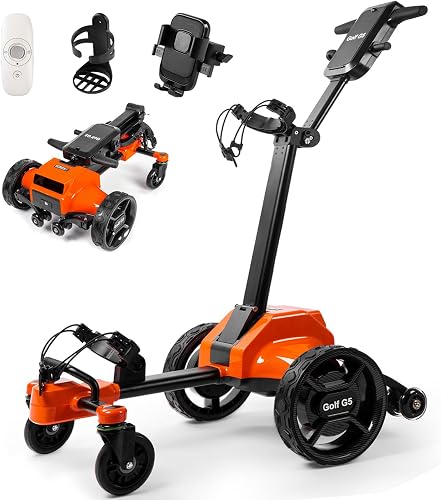
G5 Auto-Follow Electric Push Cart: Best for hands-free walking
- Auto-follow sensors
- 45-hole lithium battery
- Five control modes
- Folds in 3 seconds
A follow-me cart with the longest battery here and dual anti-tip wheels for steep ground.
Pros
- 45-hole battery
- Auto-follow plus remote and app control
- Anti-tip wheels rated for 30 degree slopes
Cons
- Largest folded size in this group
- Follow mode needs the remote to activate
The G5 Auto-Follow Electric Push Cart is for walkers who want their hands free. Sensors let it follow you down the fairway, so you can carry a club, check your phone or push a playing partner's cart without steering.
Its 45-hole lithium battery is the longest range here, covering two full rounds with room to spare. Five control modes cover hand push, remote, one-touch recall, follow and constant-speed cruise.
Dual anti-tip wheels keep it stable on slopes up to 30 degrees. It folds in about 3 seconds to 28.7 x 24.8 x 14.1 in.
A color LED display shows speed, battery, mode and mileage.
The frame arrives 90% assembled and takes about ten minutes to finish. The size is the trade-off: 28.7 in long when folded is the largest here.
Follow mode also needs the remote to activate and the battery switched on.
Pick it for long, flat-to-rolling courses where hands-free walking is worth the extra trunk space.
How these budget electric golf push carts compare
The comparison table lines up the specs that decide a purchase: weight, folded size and battery range. Scan the columns for the two or three numbers that fit your car and your course.
| Product | Best for | Weight | Folded size | Battery | Our score |
|---|---|---|---|---|---|
| Certified Brands MGI Zip Navigator All-Terrain Remote Controlled | overall | 35 lb with battery | 27.55 x 18.5 x 16.5 in | 36 holes | 8.8 |
| CaddyTek CaddyLite 11.5 V3 Push Cart | manual fallback | 13.75 lb | 28 x 16.5 x 16.1 in | 8.7 | |
| CaddyTek CaddyLite ONE-Swivel V8 Cart | turning on tight fairways | 19.6 lb | 16.5 x 20.5 x 29.3 in | 8.3 | |
| Alphard Cybercart Push+ | upgrading to electric later | 23 lb | 20 x 15.5 x 22 in | 8.2 | |
| Tivor 3-Wheel Handbrake Push Cart | wet grass and slopes | 20.5 lb | 17.3 x 24.4 x 16.3 in | 7.9 | |
| JANUS Pace 3-Wheel Push Cart | phone and scorecard storage | compact trunk size | 7.8 | ||
| KVV Remote Electric Push Cart | small trunks | 27.9 lb | 17.5 x 18.7 x 22 in | 18 holes | 7.7 |
| G5 Auto-Follow Electric Push Cart | hands-free walking | 28.7 x 24.8 x 14.1 in | 45 holes | 7.1 |
How we compared these carts
We compared specs, not test rounds. Our score weighs specs, features and buyer feedback against what you're shopping for.
Each cart got a "Best for" badge for a real use, and no badge repeats. The main checks were battery range in holes, motor type, folded size and weight.
We also looked at brakes, wheel size and storage, because a cart that holds your bag badly or rolls on a slope is a problem no motor fixes.
Prices change often on Amazon, so the ranking leans on specs and buyer feedback rather than the price of the day. One more check: how the cart folds.
A cart that folds small but takes four steps to collapse gets left in the garage.
Our guide to how to fold a golf push cart walks through the common folding styles so you know what you're buying.
Is a budget electric golf push cart worth it over a manual cart?
For most walkers who play 18 holes regularly, yes. A motor takes the load off your shoulders and back, and a remote means fewer walks back to the cart.
The budget models here still cover a full round, and some cover two. The math changes if you play nine holes, walk a flat course or already enjoy the push.
A 13.75 lb manual cart like the CaddyLite 11.5 costs a fraction of a remote cart and needs no charging.
Our roundup of the best 4 wheel golf push cart picks cover the extra-stable manual options.
When to pick a manual cart instead
Pick manual if your course is flat and under 6,500 yards, or if you walk only in cool weather. Pick manual if you hate charging one more device.
A manual cart also never loses range mid-round, and it's lighter to lift into the car.
When the motor pays for itself
Pick electric if you walk 18 holes most weeks, carry a heavy bag or play hilly courses. The MGI's 36-hole battery also pays off on golf trips where you play two rounds in a day.
The walk feels shorter when the cart does the work.
Which folding size fits your trunk?
Measure the trunk opening before you pick. The KVV folds to 17.5 x 18.7 x 22 in and the Alphard to 20 x 15.5 x 22 in, so both fit a compact sedan.
The G5 at 28.7 x 24.8 x 14.1 in needs a wider or deeper space. Length matters most.
A cart that's 28 in long when folded may fit across a hatchback but not lengthwise in a sedan trunk.
Check both dimensions against your opening, not just the spec sheet.
Small trunk and hatchback picks
The KVV is the smallest here and the easiest to store at home. The Alphard is close behind and folds flat enough to slide under a shelf.
Both are safe choices if you park in a tight garage.
Bigger carts and truck beds
The G5's 45-hole battery and follow mode come with the largest folded size. If you drive a truck or SUV with a wide bed, that trade is easy.
In a small car, the MGI's 27.55 in length is the better fit among motorized carts.
Remote control or follow mode: which do you need?
A remote puts the cart in your hand and follows your thumb. Follow mode sends the cart after you without input.
Most walkers are happy with a remote; follow mode is a convenience for long, open fairways. The MGI and KVV use a remote only.
The G5 adds sensors so the cart tracks you.
If you're comparing remote features in detail, our guide to electric golf push carts with remote control covers speed ranges, braking and how each control type behaves on slopes.
What a remote adds on the course
A remote lets you send the cart ahead on a path, stop it beside the green and bring it back without walking. That's the biggest everyday win: fewer steps back and forth.
It also means one more battery to keep charged.
When follow mode helps and when it doesn't
Follow mode helps on wide, flat fairways where the cart has room to trail you. It's less useful on tight paths with trees or bunkers in the way.
The G5 needs the remote to activate follow mode and the battery switched on, so it's not fully hands-off.
How much battery range do you need?
One round needs about 18 holes of range. Two rounds need 36.
The G5's 45-hole battery and the MGI's 36-hole battery cover a full day; the KVV's 18-hole battery covers one round. Range drops on steep courses, in cold weather and with a heavy bag.
Leave a margin: if you regularly walk 18 on a hill course, a 36-hole battery is safer than an 18-hole one.
Charge after every round and store the battery indoors.
Charging and storage habits that keep range up
Charge to full before you store the cart for the week. Keep the battery out of a hot garage or a freezing trunk.
The MGI's color-coded charger shows red while charging and green when full, which makes the routine simple.
Manual fallback when the battery runs out
The KVV switches to manual mode when the battery runs low. That's worth having if you sometimes forget to charge.
A cart with no manual mode leaves you pushing a heavy load uphill, so check for it before you buy.
Are these carts stable enough for senior walkers?
Yes, with the right wheel size and brake. Wide wheels and a foot brake make a cart easy to control, and a lighter frame is easier to lift.
Our roundup of the golf push cart for seniors covers the models with the lightest frames and simplest controls. The Tivor's 11.5 in all-terrain wheels and triangle frame suit soft ground.
The JANUS Pace's five-position handle fits shorter and taller golfers.
For a walker who wants a motor without a heavy lift, the KVV at 27.9 lb is lighter than the MGI's 35 lb.
The verdict: which budget electric golf push cart should you buy?
For most walkers, buy the MGI Zip Navigator All-Terrain Remote Controlled. The 36-hole battery covers two rounds, the twin motors handle hills and the zip fold keeps it compact.
It's the best budget electric golf push cart overall, and the 8.8 score reflects that balance. Pick the KVV if your trunk is small and one round per charge is enough.
Pick the G5 if you want hands-free follow mode and the longest battery here.
For a flat course and the lowest cost, the CaddyLite 11.5 V3 manual cart does the job without a battery to charge.
Every cart here earns its place on a specific need. Decide how far you walk, how steep your course runs and how much trunk space you have, and the choice narrows to one or two.
Our top 3 picks at a glance
-
1
Best overall
Certified Brands MGI Zip Navigator All-Terrain Remote Controlled
8.8/10 our score
See it on Amazon -
2
-
3
Best for turning on tight fairways
CaddyTek CaddyLite ONE-Swivel V8 Cart
8.3/10 our score
See it on Amazon
Frequently asked questions
How much should a budget electric golf push cart cost?
Budget electric carts sit below the premium remote models, and the gap is mostly battery size and motor count. A budget cart usually has a smaller battery or a single motor, so expect fewer holes per charge or less grip on steep hills.
Compare what each one includes, since holders and bags add up.
Do electric golf push carts work on hilly courses?
Yes, if the motor has enough torque and the wheels grip. Twin-motor carts like the MGI climb better than single-motor models.
Dual anti-tip wheels, as on the G5, help keep a loaded bag upright on slopes.
Steep downhill runs still need the remote in your hand.
Can I push an electric golf cart manually if the battery dies?
Most remote carts have a manual mode, and the KVV switches over when the battery runs low. Check that the cart rolls freely when powered off before you buy.
A cart stuck in gear on a slope is a real problem.
Is a remote control worth it on a budget cart?
A remote saves walking back and forth to the cart and lets you send it ahead on a path. It also adds cost and one more thing to charge.
If you mostly walk flat courses and stay near the cart, a manual cart like the CaddyLite 11.5 does the job for far less.
What folded size fits a car trunk?
Most sedans take a cart under about 30 in long when folded flat. The KVV folds to 17.5 x 18.7 x 22 in and the Alphard to 20 x 15.5 x 22 in.
Measure your trunk opening before you buy, since a wide folded frame can still catch on the lip.
How long does an electric golf cart battery last?
The MGI's click and go battery is rated for 36 holes, while the KVV covers 18 and the G5 claims 45. Range drops on steep courses and in cold weather.
Charge after every round and store the battery indoors to keep the cells healthy.