Best Motorized Golf Push Carts: How to Choose
The best motorized golf push cart for most walkers is a remote-controlled electric caddie with a full-round battery and all-terrain wheels. Pick by remote range and hill control first, then by folded size and weight, because those decide whether the cart is easy to live with.
On this page (7 sections)
The best motorized golf push cart for most walkers is a remote-controlled electric caddie with a full-round battery, all-terrain wheels and a folded size that fits your trunk. Pick by remote range and hill control first, then by weight and fold size, because those decide whether the cart is easy to live with.
A motorized cart does the carrying, not the walking. You still cover the course on foot, which is the point for many golfers who want the exercise without the bag on their shoulder.
This guide explains what the specs mean, how the three carts below differ and which one fits a given golfer. If you prefer to start with a shortlist, our roundup of the best 4 wheel golf push cart picks covers stability-focused options.
What makes a golf push cart motorized?
A motorized cart is an electric cart with a battery and motor that drives the wheels, so the bag moves without you pushing it. The handle or a remote controls speed and direction, and you walk alongside instead of behind a load.
The difference from a standard push cart is the drive system. A manual cart turns your effort into forward motion; a motorized one converts battery power into wheel torque.
That changes what you should compare.
Three parts matter most. First, the motor setup: twin motors give smoother control on slopes than a single drive unit.
Second, the battery, rated in holes rather than hours. Third, the control method, either a remote handset or a handle dial.
Weight follows the hardware. A cart with a 36-hole battery and twin motors carries more mass than a compact 18-hole model, and you feel that when lifting it into a car.
Fold size matters for the same reason.
Check whether the cart has a manual mode. It lets you push the cart like a normal trolley if the battery runs down or you prefer manual control on a tricky stretch.
The KVV cart offers this dual-mode setup.
Decide the control type before you shop. Remote steering suits walkers who like to send the cart ahead; a handle dial suits golfers who want simple, direct control.
How much remote range do you need?
You need enough remote range to move the cart from your parking spot to the next shot, which is usually a few dozen feet rather than hundreds. Motocaddy rates its M7 remote for up to 150+ feet, and that covers most open-course situations.
Range is a maker claim, so treat the number as a ceiling. Trees, slopes, thick rough and other carts can all cut the usable distance.
Keep the cart in sight and steer it as it moves.
More range helps in specific cases. On open fairways you can park the cart on the path and send it to the rough near your ball.
On a long walk between holes, a remote saves you from turning back for the cart.
Range matters less on tight, tree-lined courses. You'll be close to the cart anyway, and quick left and right corrections matter more than distance.
A remote with forward, reverse and pause controls gives you fine steering either way.
If you often walk with a group, think about how the cart behaves when you stop to talk. Pause and resume functions let you hold the cart still without switching it off.
Check that the handset is comfortable in your grip, since you'll hold it for most of the round.
Buy for the courses you play, not the longest possible range. A remote rated for well over 100 feet is plenty for nearly every walker.
How many holes should the battery cover?
Choose a battery rated for at least a full 18-hole round, and go to 27 or 36 holes if you play long courses or two rounds in a day. Running out mid-round turns a motorized cart into a heavy push cart.
The three carts here differ clearly. The MGI Zip Navigator has a 36-hole battery, Motocaddy rates the M7 for up to 27 holes and the KVV for 18+ holes.
All three cover a standard round when charged.
Battery chemistry matters as much as the hole count. Lithium packs are lighter than older lead-acid types and keep their power steadier as they drain.
All three models use rechargeable lithium packs.
Charging habits decide how often you get the full rating. Plug the cart in after every round rather than waiting for the battery to run flat.
A color-coded charger helps: red while charging, green when full.
Cold weather and hilly courses draw more power. If you walk in winter or play a course with long climbs, pick the largest battery in your budget.
A 36-hole rating leaves margin for both.
Some batteries lock into the frame with a lift handle, which makes removal easy for charging indoors. That matters if you keep the cart in a garage without a power point.
Size the battery for your longest regular round, then charge it every time.
Which fold size and weight suit your car?
A motorized cart should fold small enough to fit your trunk and light enough for you to lift alone. Folded size and cart weight are the two specs that decide whether the cart stays in the car or stays at home.
The MGI Zip Navigator weighs 35 lb with its battery. Its zip folding system brings the folded frame down to about 27.6 x 18.5 x 16.5 in when the rear wheels are reversed on the axle.
Reversing the wheels is an extra step, but it shrinks the footprint.
The Motocaddy M7 weighs 16 lb, which makes it the lightest of the three. A lighter cart is easier to lift into a high trunk or carry up steps.
Check the folded size against your boot space before buying.
The KVV folds to 17.5 x 18.7 x 22 in, so it packs into a small trunk. Its aluminum frame weighs 27.9 lb.
That's lighter than the MGI but heavier than the Motocaddy.
Weigh your lifting limit honestly. A 35 lb cart is manageable for many walkers but awkward for anyone with shoulder or back problems.
A lighter frame costs you battery capacity or features in return.
Our guide on how to fold a golf push cart walks through the folding steps so you can practice at home before the first round. Pick the folded size your car needs first, then accept the weight that comes with it.
How do the three motorized carts compare?
The three carts below suit different walkers: the MGI Zip Navigator is the best pick for most people, Motocaddy M7 is best for light lifting and the KVV is best for a small trunk. Each one leads on a different spec.
| Product | Best for | Our score |
|---|---|---|
| Certified Brands MGI Zip Navigator All-Terrain Remote Controlled | ||
| Motocaddy M7 Remote Electric Caddy | ||
| KVV Remote Electric Push Cart |
Best for most walkers: MGI Zip Navigator
The MGI Zip Navigator is the best motorized golf push cart overall because it balances battery, motor and terrain ability better than the other two. Its 36-hole battery and twin motors cover long rounds and hilly courses.
Certified Brands MGI Zip Navigator All-Terrain Remote Controlled

The twin motors deliver what MGI calls a smooth, whisper-quiet ride. Speed runs from 1 to 20 on the handle display, and you can adjust the ergonomic T-handle to your height.
A USB port under the handle charges your phone during the round.
The 36-hole battery locks vertically into the frame with a lift handle. Charging uses color-coded ports and a charger that shows red while charging and green when full.
That's a small detail that helps on a busy schedule.
All-terrain tread on the rear wheels handles wet grass and uneven paths. The bundle includes drink, GPS/phone and umbrella holders, plus a power bundle for charging on the move.
A magnetic microfiber towel clips to a club or the cart.
The main trade-off is weight. At 35 lb with the battery, it's the heaviest cart here, so plan how you'll lift it.
The folded size is compact once the rear wheels are reversed.
Pick the Zip Navigator for long rounds and mixed terrain. If you need to carry the cart up stairs regularly, weigh the lift against the battery advantage.
Best for light lifting: Motocaddy M7
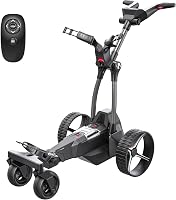
The Motocaddy M7 is the best pick for golfers who lift the cart in and out of the car often. At 16 lb it's less than half the weight of the MGI, and its remote works from up to 150+ feet.
Motocaddy M7 Remote Electric Caddy

The M7 has 9 speeds, automatic downhill control and anti-tip rear wheels. Downhill control is the useful one on sloping courses: the cart holds back on descents instead of running away from you.
Anti-tip wheels add stability on side slopes.
The compact lithium battery is rated for up to 27 holes. The remote has forward, left, right and reverse controls plus pause and resume.
A simple folding mechanism breaks it down for storage or travel.
Motocaddy includes a device cradle, drink holder, umbrella holder, scorecard holder and USB charging cable. The bundle covers the accessories most walkers buy separately.
The quiet 230W motor runs through a noise-reducing gearbox.
The trade-off is battery capacity against the MGI. At 27 holes it's nine holes short of the Zip Navigator, which matters if you play 36 in a day.
It's also lighter because it carries less battery and frame.
Pick the M7 when weight is the deciding factor. It's the easiest of the three to lift, and the downhill control helps on sloping courses.
Best for a small trunk: KVV Remote Electric Push Cart
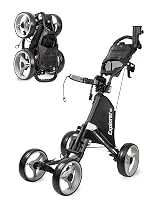
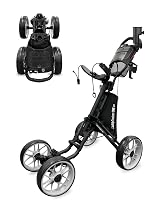
The KVV Remote Electric Push Cart is the best pick for a tight trunk or a shared car. It folds to 17.5 x 18.7 x 22 in and weighs 27.9 lb, so it takes less space than the MGI.
KVV Remote Electric Push Cart

The KVV has a dual-mode design: remote control with 9 speeds, plus a manual mode when the battery runs low. The 18+ hole battery covers a standard round.
The handle adjusts in height for different golfers, and the front wheel turns 360 degrees for tight turns.
Two training wheels and a straight-line tracker add stability on hills and rough patches. The straight-line tracker helps the cart hold a line when you send it ahead.
Accessories include a carry bag, drink holder, umbrella holder, remote holder and an insulated cooler bag.
The 360-degree front wheel makes turning easy, though a swiveling wheel also means the cart needs guidance on slopes. The 18+ hole battery is the smallest of the three, so long or hilly rounds leave less margin.
Pick the KVV when storage space is short. Its fold size is the smallest here, and the manual mode is a useful backup on a long round.
What should you know before buying a motorized cart?
Before you buy, confirm three things: the battery rating covers your longest round, the folded size fits your car and the cart's weight is within your lifting limit. Everything else is preference.
Remote steering is the biggest preference. It lets you send the cart ahead and walk freely, but it also means holding a handset and watching the cart.
A handle-dial cart is simpler to operate and harder to lose control of.
Terrain ability matters on your home course. All-terrain wheels and anti-tip designs help on wet grass and slopes.
If your course is flat and dry, a simpler wheel setup is fine and may save weight.
Think about accessories before you add them later. Drink, umbrella and phone holders are easy to buy separately, but a bundle saves time.
A USB port for charging your phone is a small feature you'll notice on a long round.
Warranty length varies. Motocaddy offers a 24-month warranty and KVV offers 2 years.
MGI's coverage comes through the Certified Brands bundle. Check the terms before you buy, since battery coverage often differs from frame coverage.
Consider how the cart behaves when you stop. Pause and resume functions matter more than top speed on a crowded course.
Buy the cart that fits your round length, car and lifting limit, then stop comparing.
Which walker should buy which motorized cart?
Pick the MGI Zip Navigator for most walkers who play long or hilly rounds, the Motocaddy M7 if lifting weight is your main concern, and the KVV if trunk space is tight. The best motorized golf push cart is the one whose weakest spec still meets your needs.
For seniors who want the exercise of walking without the bag weight, a lighter cart is often the better fit. Our guide to the golf push cart for seniors covers the features that matter most for older walkers, including handle height and lifting weight.
If you like the idea of a cart that drives itself without a remote in your hand, a follow-me model changes the experience. Our guide to the golf push cart that follows you explains how those carts track the golfer and when they suit a walker.
Test the cart on your own course if you can. A short trial reveals how it handles slopes, how the remote feels in your grip and whether the folded size really fits your trunk.
Pick by the spec you can't change later: battery, weight or fold size.
Frequently asked questions
How far can a remote control a motorized golf push cart?
Motocaddy says its M7 remote works from up to 150+ feet, which covers most situations where you park the cart and walk to your ball. Treat that as a maker claim and keep the cart in sight.
Long remote range helps most when the terrain is open and flat.
How many holes does an electric golf cart battery last?
The three carts here are rated for a full round or more on one charge. The MGI Zip Navigator and KVV are rated for 36 and 18+ holes respectively, and Motocaddy rates the M7 for up to 27 holes.
Charge after every round so the battery is ready for the next one.
Is a motorized golf push cart worth it for a senior golfer?
Yes for many older walkers, because the motor carries the bag weight and you keep the exercise of walking. Check the cart's own weight first, since a 35 lb model with its battery still needs lifting into a trunk.
Lighter frames suit anyone who struggles with lifting.
Do I still need to push a remote electric caddy?
No, you steer it. A remote caddy drives itself while you hold the handset, and many models also offer a manual mode if the battery runs low.
You still need to guide it around bunkers, paths and greens, so watch the cart rather than leaving it unattended.